


Hello and welcome to another ESC Retro-Review! Tonight, we’re setting our time-machines for Brighton 1974—where, for the fifth time, the BBC donned the hosting crown. You might wonder: Luxembourg had just triumphed in 1973 with “Tu te reconnaîtras,” so why didn’t they stage the next contest? Having already hosted two years running, Compagnie Luxembourgeoise de Télédiffusion bowed out, and Spain’s (who came second in 1973) TVE also politely declined. That left the BBC—and Brighton’s Dome—to pick up the baton, since they placed third the previous year.
As ever, our guide for the evening is the incomparable Katie Boyle—born Caterina Imperiali dei Principi di Francavilla in a Florentine palace once home to Italian royalty. Not only did she reign over Eurovision four times, but legend has it she even dispensed with her underwear under that gleaming satin dress (that looked so much like a nightgown, a running theme for the night, as you’ll see) in ’74—talk about hosting flair!
Let’s dive in, shall we?
Honorable mention
France – A Contest That Never Was
France selected Dani’s “La Vie à vingt-cinq ans” but bowed out when President Pompidou died days before the show. ORTF observed a national day of mourning—no “nul points,” just respect .
Postcards: Rehearsal Sneak-Peeks
After a two-year hiatus, the BBC reintroduced postcards—first, scenic clips, then silent interview snippets in Brighton, and finally, quick rehearsal teasers, giving us backstage glimpses before every act.
Country Highlights
Finland – Carita Holmström – “Keep Me Warm” (13th place, 4 pts)
Genuine piano playing—no miming here—and a voice as cozy as the title promises. Carita’s warm, Mama Cass–style delivery was a perfect “feel-good” opener .

United Kingdom – Olivia Newton-John – “Long Live Love” (4th place, 14 pts)
Olivia in sky-blue nightgown chic, leading a marching-rhythm anthem. Three backing singers squeezed onto one mic, two on another—classic mic-sharing! She didn’t love the song, but the juries did.
Spain – Peret – “Canta y sé feliz” (9th place, 10 pts)
Catalan rumba grooves with guitar-strap mic so Peret could play free. Five backing vocalists, three mics—loud ladies, silent gents—a riot of color and energy .
Norway – Anne-Karine Strøm – “The First Day of Love” (14th place, 3 pts)
Channeling Hair, with close-up camera work and one-mic-shared backing vocals. A high-octane slice of 70s musical theatre that still uplifts .
Greece – Marinella – “Krassi, Thalassa kai T’ agori mou” (11th place, 7 pts)
Debut bouzouki riff, sun-soaked melody—you could almost taste the ouzo. Two mics for four singers left harmonies buried, but that tambourine never sounded so headless .
Israel – Poogy – “Natati La Khayay” (7th place, 11 pts)
Six Beatles-style chaps kick off with rock riffs before slipping into folk-rock melancholy. That haunting melody made it an instant classic .
Yugoslavia – Korni Grupa – “Generacija ’42” (12th place, 6 pts)
WWII, milk shortages, glam-rock jackets in pastel hues—camp rock opera at its finest. “Dream of milk”? Only at Eurovision.

Sweden – ABBA – “Waterloo” (1st place, 24 pts)
Napoleon-cap conductor, circus-camp costumes, that pounding hook—Waterloo detonated on stage and launched pop history.
Luxembourg – Ireen Sheer – “Bye Bye I Love You” (4th place, 14 pts)
Another nightgown moment, marching beat, bilingual tease, but there’s no real hook —Luxembourg clearly didn’t want a repeat win, but this isn’t the last we hear from Ireen Sheer.
Monaco – Romuald – “Celui qui reste et celui qui s’en va” (4th place, 14 pts)
Purple bowtie, cow-pattern backing dresses, and a French ballad that burned bright but not quite brightest.
Belgium – Jacques Hustin – “Fleur de Liberté” (9th place, 10 pts)
Oversized collars, Renaissance-tinged melody, dark suit—solid musical-theatre vibes, if a bit by-the-book .
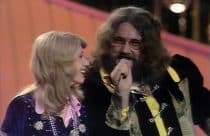
Netherlands – Mouth & MacNeal – “I See a Star” (3rd place, 15 pts)
Bear-like lead, circus chic backing, barrel organ onstage—Eurovision whimsy with a punch.
Ireland – Tina Reynolds – “Cross Your Heart” (7th place, 11 pts)
Daring cut-out nightgown, sing-along “la-la” refrain—march-pop comfort food.
Germany – Cindy & Bert – “Die Sommermelodie” (14th place, 3 pts)
Versace-proto dress (imagine JLos Versace dress, but with much more fabric), clashing greens, minor-to-major chorus twist—ambitious, if exhausting.
Switzerland – Piera Martell – “Mein Ruf nach dir” (14th place, 3 pts)
Flowing green “nightgown,” Hair-style theatrics—extravagant, though one more variety show act than standout entry.
Portugal – Paulo de Carvalho – “E Depois do Adeus” (14th place, 3 pts)
Smooth Sinatra-vibes, rhythm switches—and the note that sparked the Carnation Revolution.
Italy – Gigliola Cinquetti – “Sì” (2nd place, 18 pts)
1964 winner returns with dreamy orchestration and a politically charged melody (so to say censored in Italy itself due to an upcoming divorce referendum). Four women on one mic—hearing every note is an understatement .
Interval Act
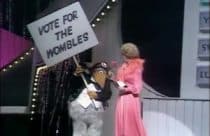
The Wombles
A pre-recorded romp featuring the Wombles scampering through Brighton’s Pavilion—delightfully absurd and unabashedly child-centric, their playful antics lean fully into Saturday-morning silliness… in a show that airs late Saturday evening.
Results
Ten Jurors, One Vote Each
In Brighton 1974, organisers planned a sophisticated hybrid: ten-member juries giving 1–5 points to every song, plus a random “lottery” draw on stage for voting order. But rehearsals revealed it was simply too time-consuming and error-prone—computerised tallying was deemed too expensive to implement. So, at the last minute, executive producer Bill Cotton reverted to the old reliable, last time used in 1970: each of the ten jurors in every country had exactly one vote to award to their single favourite entry.
- Pre-show Lottery: Although the on-stage ballot was dropped for time and sound-quality reasons, the EBU scrutineer Clifford Brown still conducted a random draw before the contest to decide the order in which countries would announce their votes.
- Points given in performance order: The votes were given out to all the songs in performance order and the juries were – as per Katie Boyle’s words, sequestered so they didn’t know how the country before them voted or what the scoreboard looked like at that moment.
- Phone-Line Protocol: If a jury’s telephone line failed mid-vote, BBC engineers would redial. Failing reconnection, that country’s score was simply null and void—a harsh but necessary rule to keep the show on schedule.
- Studio-Quality Sound: Unlike past years’ crackly venue-lines, Brighton ’74 used dedicated landline circuits and in-venue mixing to deliver crystal-clear jury announcements—so clear you’d swear the jurors were standing at the foot of the stage.
This swift rollback preserved the ten-juror format already in place, while streamlining the live tally and maintaining the contest’s trademark drama. But – it was hard to follow the voting and scoreboard, since every country gave out only 10 points and you never knew what came next and in which order – and it was even visible on the performer’s faces when they showed the Green room.
Final Thoughts
1974 was the perfect camp cyclone: nightgown couture, Greek bouzouki turns, and the seismic birth of ABBA’s Waterloo. The top five were:
- 1 – Sweden, ABBA, “Waterloo” – 24 pts
- 2 – Italy, Gigliola Cinquetti, “Sì” – 18 pts
- 3 – Netherlands, Mouth & MacNeal, “I See a Star” – 15 pts
- 4 – Luxembourg, Ireen Sheer; Monaco, Romuald; United Kingdom, Olivia Newton-John – 14 pts (three-way tie)
- 7 – Israel, Poogy; Ireland, Tina Reynolds – 11 pts
The gap from first to third was a mere nine points—proof that even in its campiest era, Eurovision was fiercely competitive. But imagine today someone winning with only 24 points? I think it’s safe to say that Abba is the winner with the least amount of points in comparison to the impact they had.
Brighton ’74 wasn’t just the year ABBA stormed the stage with Waterloo—it was Sweden’s very first win, and that cheeky “Napoleonic defeat” quickly became a global smash, catapulting the quartet into the stratosphere and laying the foundation for them to become one of the best-selling acts in history. Olivia Newton-John, fresh from her sky-blue nightgown anthem, used her Eurovision moment as a springboard into a film and music career that would see her dominate both the UK and US charts. Meanwhile, Portugal’s understated “E Depois do Adeus” did more than finish the show—it secretly sounded the starting pistol for the Carnation Revolution back home, triggering a coup that ended decades of dictatorship.
Together, these ripples made 1974 a turning point: a contest that proved Eurovision could launch global superstars, influence history, and cement its own mythos—all in less than four minutes of live music.
Next stop: 1975—Stockholm’s Sankt Eriks-Mässan trade hall doubled as our contest stage while outside, left-wing activists rallied against what they saw as music’s creeping commercialisation, even staging an Alternativfestival alongside Eurovision. Inside, Teach-In’s “Ding-a-Dong” proved that a bouncing, sing-along tune can somehow be the saddest-sounding fun song ever, and, of course, we welcomed the debut of the 12–10–8… voting system we still know and love. Skål!
Guest Author: Miljan Tanić
